A Carolina's Choice Real Estate guide for buyers already comparing Southern NC coastal towns — by history, atmosphere, and what a normal week feels like.
Buyers already looking on the Southern NC coast rarely type “Southern NC coast” into Google. They type the questions that actually decide a Saturday drive:
- What’s the difference between Wrightsville Beach and Carolina Beach?
- Is Wilmington better as a home base than a beach address?
- Oak Island vs. Ocean Isle Beach — which feels more year-round?
- What is Southport known for besides the waterfront?
- Which beach towns near Wilmington stay quieter?
- What’s actually historic here, and what’s just coastal-cute?
Those are fair questions. This stretch is not one beach with different zip codes. It is a port city, three New Hanover beaches with three different tempos, a harbor town where the river meets the ocean, and two Brunswick islands that were built for different kinds of weeks.
The numbers explain why so many people are comparing them. Visitors spent more than $1.2 billion in New Hanover County in 2025, ranking the county seventh in the state for visitor spending. Across New Hanover, Brunswick, and Pender, visitor spending reached about $2.65 billion and supported roughly 14,000 tourism jobs. Statewide, travelers spent a record $37.2 billion in North Carolina in 2025. Tourism is the engine. The towns still do not feel the same.
Wilmington: the home base, not the beach
Wilmington is the only place on this list that works like a real city first. It was laid out on the Cape Fear in the late 1730s and grew as a deep-water port. That history is still walkable. The Wilmington Historic District covers 230-plus blocks on the National Register — brick streets, live oaks, churches, and river warehouses that now hold restaurants instead of cotton.
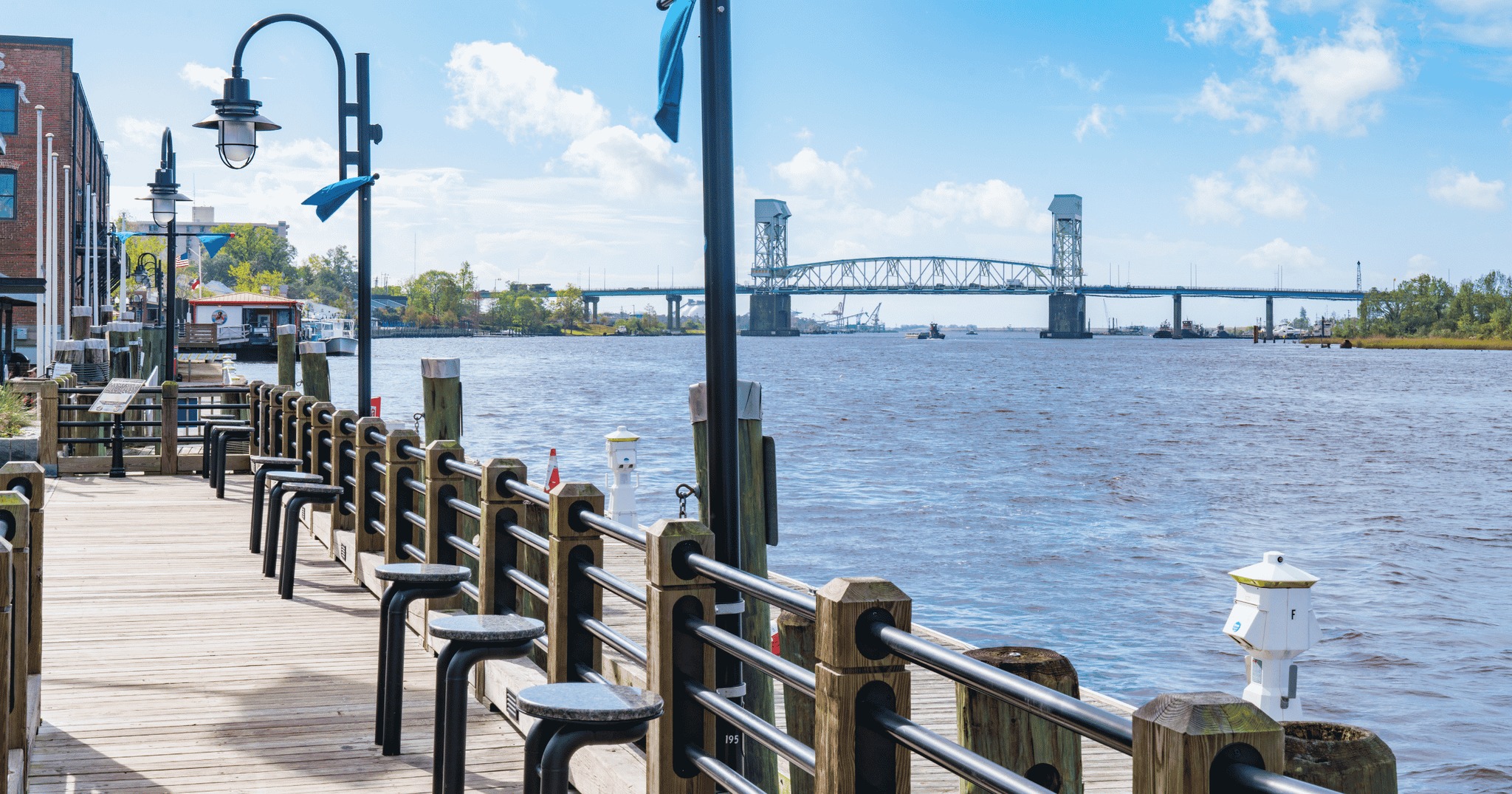
The Riverwalk is the city’s front porch: nearly two miles along a working river, with the Battleship North Carolina across the water. Add UNCW, the airport, hospitals, grocery runs that do not require a bridge, and a film history that still shows up on street corners, and you get the atmosphere in one line. Wilmington is a year-round town that happens to sit ten to twenty minutes from the ocean. If you want Tuesday in February to include a hardware store, a museum, and dinner downtown, start here and treat the beach as a short drive.
Wrightsville, Carolina Beach, and Kure Beach: same county, three weeks
People lump “Wilmington beaches” together. Locals do not.
Wrightsville Beach is the closest ocean to downtown and the most active. The water is often clearer than the beaches farther south. Surf culture is real, Johnnie Mercers Pier is an institution, and the island is small enough that you feel the restaurants, the loop road, and the sand in the same afternoon. It is the beach you pick if you want the water and Wilmington in one day. Southern Living readers have consistently ranked it among the South’s stronger beach towns for that mix of coastline and walkable amenities.
Carolina Beach is the classic boardwalk town. More neon, more events, more “we came to the beach” energy. The boardwalk, the pier, and the calendar of festivals give it a vacation-strip pulse that Wrightsville does not try to match. If you want a place that still feels like a beach trip when you pull in, this is usually it.
Kure Beach is the quieter sister at the end of the same peninsula. The sand is still there. The volume drops. Next door is Fort Fisher State Historic Site, the earthwork fort that kept Wilmington open as the Confederacy’s last major port until January 1865. The North Carolina Aquarium at Fort Fisher and the Fort Fisher–Southport ferry sit on the same tip. Kure is the answer when someone asks for a slower New Hanover beach that still has something serious to visit on a rainy day.
One peninsula. Three atmospheres: surf-and-dinner, boardwalk-and-events, quiet-and-history.
Southport: the harbor, not the strip
Cross the river — or take the ferry from Fort Fisher — and the mood changes again. Southport sits where the Cape Fear River, the Intracoastal, and the Atlantic come together. It is a river town that faces the ocean, not a high-rise sandbar.
The streets are the point: live oaks, a yacht basin, galleries, and a waterfront that still reads as working water. The North Carolina Maritime Museum at Southport interprets the lower Cape Fear — pilots, wrecks, fishing, and the river’s military past — on the old Fort Johnston grounds. Fort Johnston itself dates to the mid-1700s; Patriots burned it in 1775 and the royal governor left the colony for good. Southport is also the mainland door to Bald Head Island and the official home of North Carolina’s Fourth of July Festival.
If Wilmington feels like a small city and Wrightsville feels like an active beach, Southport feels like a porch town with a current running past it. Film crews have used those streets for a reason. The atmosphere holds in January as well as July.
Oak Island vs. Ocean Isle Beach
These two get compared because they are both Brunswick Islands. They were not built the same.
Oak Island is the larger, more lived-in beach. Long Beach and Yaupon Beach merged into one town in 1999. You feel that in the number of public accesses — more than sixty — and in the mix of year-round residents, fishing piers, and everyday errands that do not all require leaving the island. The Oak Island Lighthouse stands just next door at Caswell Beach. The vibe is community first, resort second. It is the Brunswick beach that most often answers “we actually live here.”
Ocean Isle Beach was planned after World War II by Odell Williamson as a family island: ocean on one side, canals on the other, a commercial core, and the rest kept residential. That plan still shows. The Museum of Coastal Carolina sits a couple of blocks off the sand. Each October the North Carolina Oyster Festival takes over Town Center Park. The Fourth of July parade is a local landmark. Ocean Isle feels more like a designed vacation island that families return to than a merged pair of old beach towns.
Same county chain. Oak Island is broader and more year-round. Ocean Isle is tighter, canal-and-ocean, festival-forward.
Holden Beach, Sunset Beach, Bald Head Island, and mainland towns like Leland and Shallotte fill out the rest of the map. They matter. They are not the same decision as the seven above.
Which town fits which buyer
- City conveniences, history, and a beach commute: Wilmington.
- Surf, clearer water, and downtown ten minutes away: Wrightsville Beach.
- Boardwalk energy and a classic beach-town week: Carolina Beach.
- Quieter sand plus Fort Fisher and the aquarium: Kure Beach.
- Walkable harbor, river light, and year-round streets: Southport.
- More access, more locals, island-as-hometown: Oak Island.
- Family island, canals, museum and festival calendar: Ocean Isle Beach.
The right town is the one whose Tuesday in February still feels like you. Summer crowds do not tell you that. A February grocery run does.
At Carolina’s Choice Real Estate we work this same stretch — Wilmington through Wrightsville, Carolina Beach, Kure Beach, Southport, Oak Island, and Ocean Isle. If you are already comparing these towns as a place to buy, we can walk the differences with you.
Call (910) 877-8580
Visit carolinaschoicerealestate.com
Check out this article next